
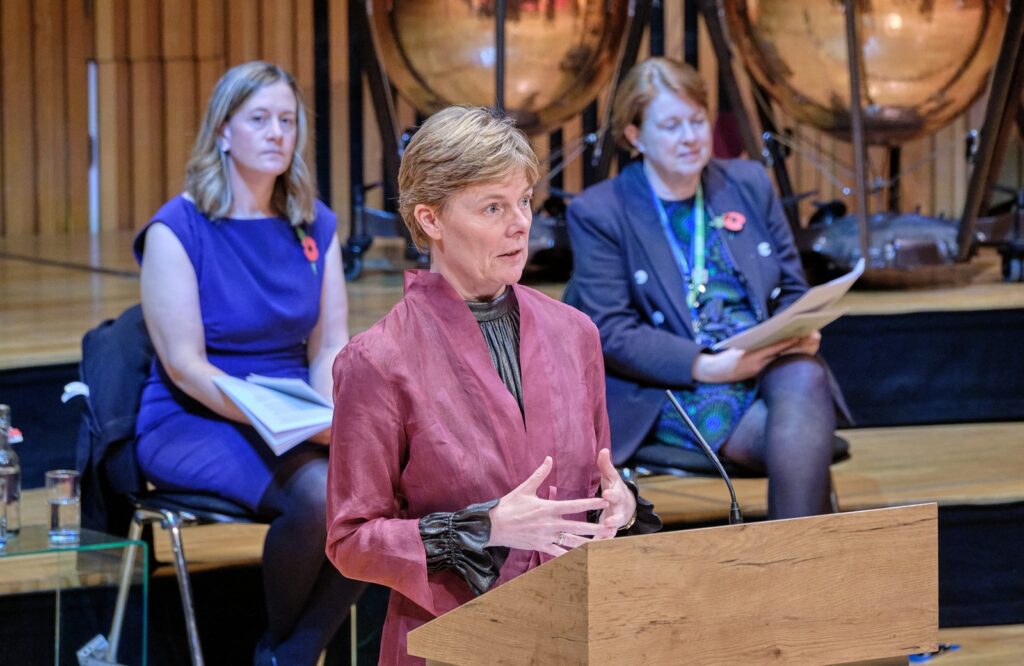
Ladies and gentlemen, governors, colleagues, parents, distinguished guest, and most importantly, our prizewinners: today we celebrate achievement in the past year. But as well as looking back, Prize Giving is also an opportunity to pitch forwards just as you have inevitably done in the last few months in your own lives. It invites me, as Principal, to share something I think important about the kind of women we hope you will become as a result of having belonged to this community. And this year, my theme is something very close to my heart.
Headship is different every day. As well as the predictable matters, there are always surprises. One of the more bizarre moments I had last year was when a group of parents somewhat breathlessly engaged me in conversation on Open Day with the question, “How is your new Lamborghini?” Apparently, they had earnestly been informed by their daughters that I had seriously upgraded my transport.
There’s a lesson in there somewhere about always taking your child’s word at face value.
I can assure you that I would never drive a Lamborghini. Firstly, it would be an incongruous look for a Principal on several levels- whilst I do have the right to a private life, I am aware of my responsibilities in representing the values of the school and of my role. Secondly, I would never personally choose to spend a great deal of money on a car. I make no wider judgement on those who do. It must be a lot of fun to drive something so expertly designed. For the avoidance of doubt, as our legal friends like to say, my car is a 13 year old Škoda: reliable, big enough to transport a harp and, crucially, one of the cars least likely to be targeted for theft in our second city, as our guest speaker [Detective Superintendent Hannah Whitehouse of West Midlands Police, OE 1997] may or may not be able to confirm.
Now, I realise that moving from Lamborghinis to books is not the most obvious transition in a Prize Giving speech. But bear with me. Both tell us something about what we value.
Can we already hear the silent groaning in a hundred young hearts? Another analogue teacher going on about useless dead tech that has been made obsolete by everything, from search engines to AI. But bear with me.
A Lamborghini is designed, beautifully, to attract attention. A book, by contrast, sits quietly on a shelf asking almost nothing of you. Yet one of those things is vastly more likely to change your life, enlarge your mind and improve your ability to contribute to society. And it isn’t the Italian sports car. It is the thing which makes us more human.
That distinction matters because we are living through an age that increasingly rewards the conspicuous over that which must be discovered, wrestled with, and understood. Ours is an age that increasingly values the explicit over the implicit, the single answer over the appreciation of complexity and ambiguity. Which is why, today, I want to talk, with urgency, about reading.
Prize Giving, as one of the longstanding annual rituals in the school calendar, invites us to ask what our predecessors would recognise in the school they created. I rather suspect Miss Creak and Miss Major would be bewildered by TikTok, astonished by artificial intelligence, horrified by league tables, specifications, prescriptive mark schemes, and the dominance of compliance, and deeply sceptical of Lamborghinis.
But I also suspect they would recognise one thing immediately: a community of young people gathered around books.
Reading has survived every technological revolution humanity has produced, because it does something no shortcut can accomplish. It forces us to think. It often forces us to pursue a sustained argument, or to engage with the details of an imagined world. It nudges us to empathise. It helps us to see the whole of a picture. It helps us to connect. And, in an age when shortcuts to thinking are readily available, and where thinking is sometimes shut down in a “no debate” culture, that matters now more than ever.
I don’t think there is much dispute that reading is one of humanity’s greatest inventions. It allows ideas to travel across continents and centuries. Civilisation is a conversation, and reading is how we keep that conversation going- or, as the poet W.H. Auden put it, ‘breaking bread with the dead.’
Now, I am often unkind to communism and its proponents in my public addresses. Today, however, I can quote the founder of communism with some approval, for political balance perhaps.
This is what Karl Marx had to say about reading in 1844.
For those in the room unfamiliar with Marx’s views, “capital”, our possessions and our wealth, was a dirty word, and the state of being “alienated” is feeling profoundly disconnected from human presence in a society which values material things, Lamborghinis perhaps, above all others. He wrote:
“The less you….buy books, go to the theatre or to balls…..and the less you think, love, theorize, sing, paint, fence, etc., the more you will be able to save and the greater will become your treasure … The less you are, the less you express your life, the more you have, the greater is your alienated life.”
To repackage this, the more you value the material, and the less you read, the less you are, and the less you will express your life. In contrast, the balance sheet of alienation, of profound disconnection from human presence, will increase.
Marx read extensively across many disciplines, including history and literature, to build his critique of capitalism in Das Kapital. As well as seeing reading as essential to the fullest human expression, he also, unsurprisingly, saw it as essential to developing critical thinking which could then lead to political action.
Marx’s central point is larger than politics. Human beings diminish themselves when they reduce life to acquisition alone. Reading extends us because it exposes us to ideas, experiences and possibilities beyond our own immediate circumstances. It develops not simply knowledge, but discernment. And discernment is one of the foundations of freedom, to which there can be no shortcuts.
A democracy depends on people who can weigh evidence, detect bias, follow an argument and imagine perspectives other than their own. These are not skills we acquire by accident. They are cultivated through the slow, deliberate engagement and discernment that reading demands.
When you read, you practise the mental habits that a successful democracy relies upon: patience, scepticism, empathy and the ability to hold complexity in your mind without rushing to premature judgement.
Therefore, a society that stops reading does not simply become less literate; it becomes less free. We become slaves to whims, to poor judgement, dare I say it to populism on both sides of the political spectrum. And yet this raises an obvious question. If reading matters so much, why does modern life seem increasingly hostile to it? Do we not, after all, value freedom, or, as William Blake put it, are we quite content living with ‘mind-forged manacles’?
In Marx’s day, the chief enemy was illiteracy. In ours, the threat to reading comes through the monetisation of even greater distraction and through the availability of shortcuts to thinking.
We all know the lure of the endless scroll: the flickering carousel of YouTube Shorts, TikTok clips and bite-sized content. These offer stimulation without depth, reaction without reflection, a representation of the world which diverts our attention from the actual, present, world. They are engineered to keep us watching, not thinking. To adapt the famous quotation from the architect Frank Lloyd Wright, this is chewing gum for the eyeballs, or to adapt Karl Marx, this is real opium for the masses. Our young have a different phrase that means the same thing: they call it ‘brainrot’. It’s bad for the brain. Now hold that word ‘brain’ in your minds, because I will come back to it.
There is another aspect of modern life that our former Principals would not recognise.
Education was intended to enlarge minds. Yet now we are often tempted to reduce it to that which can be measured. The specification, the mark scheme and the performance metric can become substitutes for learning itself. Knowledge begins to look less like a conversation and more like a fixed commodity.
The very real danger is that we start to believe that the purpose of education- whether at school or at the universities most of you are now attending- is simply to pass the examination, secure the place, obtain the qualification. Learning becomes valuable only insofar as it delivers an outcome. The process matters less than the fixed result. But today, what is that result? We are rightly being told that many careers are in flux as AI develops. One of the most important results of a good education is going to have to be to make you adaptable, to communicate well and to be able to work productively with a broad range of people- exactly what you will have learnt to do here- and for that we will need to use all of our faculties.
Now I do practise what I preach: I read extensively. My own reading has lately led me to the work of Iain McGilchrist, Professor at All Soul’s College, Oxford, neuroscientist and philosopher, whose tome ‘The Matter with Things’ has been described as ‘one of the most important books ever written’. That is ‘ever’, and, 900 pages in (just over halfway through), I can see why. I urge you to read it. Beginning with the different contributions of the brain’s two hemispheres, left and right to the way we see the world, he argues that modern Western culture increasingly privileges what can be measured, categorised, standardised and controlled- the activity of the left hemisphere, whilst paying less attention to qualities such as perspective, imagination, empathy, context and an appreciation of complexity, which is what the right brain brings us, and which, he argues, is crucial for human flourishing, and also for scientific advance.
In McGilchrist’s terms, reading cultivates precisely those habits of mind that modern life often discourages: attention rather than distraction, understanding rather than simply information, connection rather than the mere accumulation of disparate facts. It is an antidote to brainrot.
Schools and universities are not immune from this age of metrics, targets and performance indicators. Neither are individuals. But reading pushes powerfully in the opposite direction.
A good book refuses to reduce reality to a soundbite. It requires us to sit with uncertainty, to encounter perspectives not our own and to recognise that human affairs are rarely simple. The great truths of literature, history, philosophy and religion, are often not problems to be solved but realities- how the world is- to be understood.
When we read fiction, we enter minds other than our own. When we read history, we discover that intelligent people have reached very different conclusions about the same events. When we read philosophy, we learn to wrestle with big questions, and find that questions worth asking are seldom answered in a paragraph. Reading teaches us to hold competing ideas in tension without immediately demanding certainty.
That is why reading matters so much to education, and therefore to all of us gathered here today to celebrate educational excellence. Not because it helps you answer examination questions, although it often does. Not because it improves your vocabulary, although it certainly will. Not because it will make you more attractive to potential partners- that’s a matter of taste- but nowadays there is something immediately striking about someone reading a book in public.
It matters because it incrementally changes how you see the world.
Although they approached the world from very different starting points, Marx and McGilchrist share a concern. Both warn against reducing human life to that which can be possessed, grasped, counted or controlled.
Reading’s superpower is that it refuses to be instrumentalised. You cannot read just to pass an exam. You read to understand, to question, to wander, to wonder. Reading is gloriously inefficient and yet it is a long-term capital investment in yourself, one that even Marx was prepared to make.
Our first Principal, Miss Creak, and her successors, established this school so that young people could grow minds capable of wisdom, judgement, discernment and intellectual independence. And a brief look at the roll call of OEs indicates that that is what the school has achieved. There are a lot of trailblazers, mavericks, and independent-minded women of distinction who have passed through our portals. You yourselves are now on the other side of that portal, and I have every confidence that you will distinguish yourselves- as long as you keep reading, of course.
The Prizewinners
And so, to our prizewinners: today we celebrate your achievements. Congratulations. Enjoy your book tokens.
If you want to continue to flourish, intellectually, professionally and personally, read.
Read widely.
Read bravely.
Read things that challenge you, that unsettle you, that make you rethink what you thought you knew.
Read things that are difficult.
Read things that are beautiful.
Read things that are neither, but which open a door you did not know existed.
And to all of us, teachers, parents and members of our wider community- we must champion and defend reading. Not nostalgically, but urgently, as vital to the expression of the fullest humanity.
We must protect time for it, space for it and overtly value it- above that which is shiny, unenduring, reductive, or simplistic.
Because if we want young people who can navigate a world of complexity, who can resist manipulation, who can imagine better futures and who will one day lead us and others to them, then we must give them the one tool that has never failed civilisation yet: the ability to read deeply.
Our founders believed in education as a civilising force. So let us continue to build a school, and beyond that a society, where reading is not an optional pastime but a vital practice in order to meet our full human potential.